
by Paul Wolstenholme, Associate Director of Data Ecology, Envance
Environmental due diligence tends to look upward and outward: trees to be retained, hedgerows to route around, buildings inspected for roosting bats. Beneath the waterline, an equally consequential picture can go unnoticed until a project is already committed to a design, a programme, and a budget.
The Rochdale Canal – a great illustration
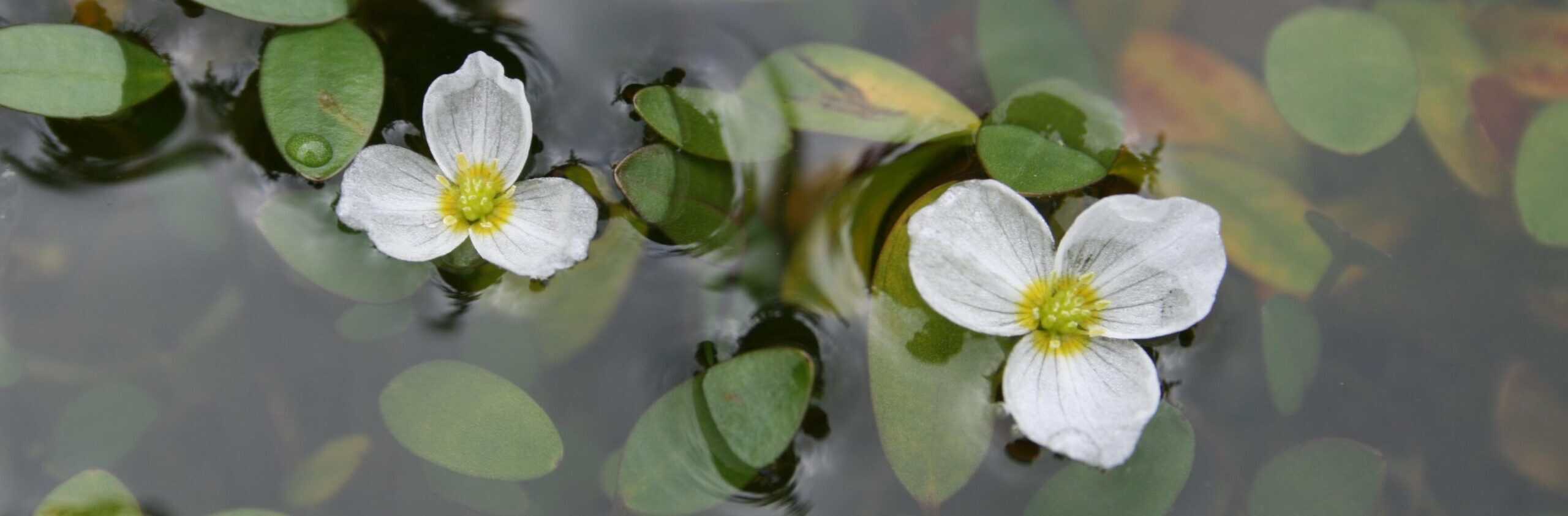
Long sections of the Rochdale Canal carry Site of Special Scientific Interest and Special Area of Conservation status, protections unrelated to anything visible from the towpath. They exist because the canal supports dense, nationally important populations of floating water-plantain, a small aquatic plant with oval leaves and delicate white, three-petalled flowers. It is easy to walk straight past. It is also a European Protected Species, and works affecting the channel, from cable crossings and outfall repairs to dredging or bridge works, can trigger licensing obligations most people would never associate with an ordinary-looking stretch of urban canal.
This is not a quirk specific to one waterway. Aquatic and marginal plant communities sit within rivers, canals, ditches, ponds and reservoirs across the UK, and some carry the same weight: statutory designation, protected species status, or enough ecological value that an Environmental Impact Assessment cannot proceed responsibly without knowing what is there.
Surveying this habitat is more involved than a bankside walkover
Depending on depth, flow and clarity, ecologists may wade the margins, survey from a boat, or use a grapnel thrown and retrieved along transects to sample submerged vegetation invisible from the surface. Findings are typically recorded against national plant classification standards, comparing a site's aquatic flora against known reference communities. Where a European Protected Species such as floating water-plantain is present or suspected, survey effort must support a genuinely defensible presence or absence conclusion, since a licensing decision, and by extension a construction sequence, may rest on it.
The central complication is timing
This is where many programmes come unstuck. Floating water-plantain is most confidently identified when in flower, in the Summer, when its floating leaves and flowers sit visibly at the surface. Outside that window, the plant can die back, remain submerged in a vegetative form, or become difficult to distinguish from superficially similar species, particularly in turbid or fast-flowing water. A survey undertaken too early in spring, too late into autumn, or during poor visibility can produce a result too weak to support a planning or licensing decision, regardless of how carefully it was conducted.
For a project with any interface with a watercourse, whether direct works within the channel or nearby activity risking run-off, sedimentation or disturbance, this timing constraint has real consequences. Missing the optimal survey window does not simply delay a piece of fieldwork. It can delay the entire chain of decisions, and on projects requiring an EPS licence or an assessment under the Habitats Regulations, missing this year's flowering season often means waiting for the next one. Aquatic vegetation of this kind rarely offers a meaningful second window before autumn dieback, and a licence application built on an inconclusive survey is a poor foundation for a programme with fixed contractual dates.
You only know when you know
Many stretches of canal, river and pond support nothing of particular conservation concern, and a proportionate survey establishes that quickly. The argument is for finding out early enough that the answer can still be built into design and programme decisions, rather than surfacing once the season for finding out has closed. For clients in construction, infrastructure, rail and water, that foresight often separates a manageable ecological constraint from an expensive one.
written by Paul Wolstenholme, Associate Director of Data Ecology, Envance
Want to see Paul's interview? Take a look.